Patient Operations Modernization
Mid-sized UK and European healthcare providers operating across multiple specialties face mounting pressure on patient pathway efficiency as referral volumes grow beyond what paper-based and legacy digital processes can manage. Referral coordination, appointment scheduling, and care communication still depend on manual triage, phone calls, and disconnected clinical systems — creating delays in patient care, high administrative burden on clinical teams, and limited visibility for operational and finance leadership.
Region
UK & Europe
Industry
Healthcare
Client
Available on request
The Problem
The operating challenge
Mid-sized UK and European healthcare providers operating across multiple specialties face mounting pressure on patient pathway efficiency as referral volumes grow beyond what paper-based and legacy digital processes can manage. Referral coordination, appointment scheduling, and care communication still depend on manual triage, phone calls, and disconnected clinical systems — creating delays in patient care, high administrative burden on clinical teams, and limited visibility for operational and finance leadership.
Operating context
This scenario is set in an independent healthcare provider or NHS Foundation Trust operating across three to eight specialties and two to four sites, with a patient pathway that spans GP referral, specialist consultation, diagnostics, treatment, and follow-up. Clinical administration teams manage hundreds of referral letters weekly through a mix of NHS e-RS, fax, email, and phone — with triage and appointment booking handled manually by specialty-specific admin teams. EPR systems are in place but integration between systems is limited, and patient communication remains largely phone-based. Regulatory context includes CQC standards, ICO data obligations, and NHS Accessible Information Standard requirements.
Problem signals in this scenario
Referral letters triaged manually by admin staff with inconsistent prioritisation criteria
Appointment booking requiring 3–5 phone calls per patient on average
No structured digital communication pathway for patients after referral acceptance
Average time from referral receipt to booked appointment exceeding 10 working days
Clinical admin team spending >40% of time on inbound patient enquiry calls
Specialty teams maintaining shadow Excel trackers because EPR reporting is insufficient
Approach
How CodeCones would approach it
Hover any stage to reveal additional technical detail.
Referral Ingestion and Digital Triage
Referral letters from NHS e-RS, GP email, and paper channels are ingested through a unified intake layer. Document AI extracts clinical priority indicators and patient details to support consistent, structured triage.
Technical detail
Azure Form Recognizer or AWS Textract processes incoming referral letters. Extracted fields mapped to the organisation's triage criteria. Structured triage objects routed to specialty queues without manual data entry by admin staff.
AI-Assisted Clinical Triage Support
An AI layer surfaces relevant clinical context from the referral — presenting indicators against the specialty's prioritisation criteria — to support faster, more consistent triage decisions by the clinical team.
Technical detail
NLP layer identifies clinical priority signals from unstructured referral letter text. Structured output presented to the triage clinician alongside the original letter. Clinician retains full authority over triage decision — AI is a decision-support tool, not an autonomous triage system.
Digital Patient Pathway and Communication
Accepted referrals trigger a structured digital patient pathway — sending automated, personalised communications via SMS and email at each stage (referral accepted, appointment offered, appointment confirmed, pre-appointment guidance).
Technical detail
Patient communication preferences captured at registration (NHS AIS compliant). Automated messages sent via a clinical communication platform with GPT-4o personalisation for tone and clarity. All communications logged to the patient record.
Self-Service Appointment Booking
Patients receive a secure link to confirm or reschedule appointments through a digital self-service interface, reducing inbound call volume for appointment-related enquiries.
Technical detail
Online booking interface integrates with the EPR scheduling module. Confirmation and reminder messages sent automatically. Cancellation and rescheduling requests processed without admin involvement for standard appointment types.
Pathway Visibility and Capacity Planning
Operational dashboards provide specialty leads and directorate managers with real-time visibility into referral queue depth, wait time by priority band, capacity utilisation, and RTT trajectory.
Technical detail
Near-real-time dashboard built on Redshift or Azure Synapse, fed from EPR event data via an integration layer. RTT calculator updated continuously against NHS rules. Directorate-level and trust-wide views with drill-down to specialty and clinician level.
CQC Audit Trail and Compliance Reporting
Every triage decision, patient communication, appointment event, and pathway milestone is logged with timestamp, actor identity, and data source — providing a complete audit trail for CQC inspection and ICO data access requests.
Technical detail
Immutable event log with field-level change tracking. Audit export produces a structured chronological patient pathway record. DSAR response time reduced by automated extraction of patient data trail from the event log.
Architecture
Representative architecture and toolset
Representative technology options. Specific tools are selected based on your architecture, existing platforms, and engineering requirements. Hover any category to see examples.
Representative technology options. Specific tools are selected based on your architecture, existing platforms, and engineering requirements.
Document AI and OCR
- AWS Textract
- Google Document AI
- Azure Form Recognizer
Process and workflow engines
- Low-code workflow automation
- BPM platforms
Large language models
- OpenAI GPT models
- Anthropic Claude
- Google Gemini
API gateway and service mesh
- Kong
- AWS API Gateway
- Istio
Observability and alerting
- Datadog
- New Relic
- Grafana
- PagerDuty
Delivery
People. Technology. Outcomes.
People
Engineering disciplines involved in this scenario
Technology
Architecture and toolset categories for this scenario
Outcomes
KPIs this solution can influence
Outcomes
Illustrative outcome profile
These figures are illustrative targets drawn from comparable industry benchmarks. They are not results achieved for a specific client. Actual outcomes depend on your organisation's baseline, technology environment, and implementation approach.
~50%
Reduction in inbound call volume for routine appointment enquiries in comparable deployments
3–5 days
Target referral-to-booked-appointment time in this modeled scenario
<30 min
Average admin time per accepted referral in this scenario
Delivery approach
Build. Scale. Ship.
Build
Start with a single specialty on a single site. Implement the digital intake and triage support layer first — this is the highest-leverage intervention. Run alongside existing admin process for 4–6 weeks before replacing manual triage entirely.
Scale
Expand to additional specialties using the same intake and triage infrastructure. Add self-service booking and digital communication pathway once triage layer is stable. Build operational dashboards using accumulated referral and pathway data.
Ship
Full multi-specialty, multi-site deployment with CQC audit trail, ICO-compliant data management, and NHS-AIS communication compliance. Quarterly model evaluation for AI triage support. Annual IG review and DPIA update.
Recommended engagement model
Managed Product Engineering
CodeCones takes ownership of a defined delivery outcome with an experienced pod working in your toolchain.
Embedded Engineering Specialists
Experienced engineers join your existing team and toolchain, extending capacity without a standalone team structure.
Services
Related service pathways
Hover any card to see the role of each service in this scenario.
AI Product Development
CodeCones service
Clinical document AI, triage support tooling, patient-facing communication platform, and digital self-service booking interface
Managed Product Engineering
CodeCones service
End-to-end pathway platform delivery, EPR integration engineering, operational dashboard build, and compliance audit layer
Governance
Built-in controls for this scenario
Clinical Decision Authority Preserved
AI triage support is explicitly framed as decision assistance, not autonomous clinical triage. All triage decisions are made and recorded by a named clinical member of staff, with the AI output logged as an input — not the decision.
NHS-AIS Compliant Communication
Patient communication channels, formats, and language compliance meet NHS Accessible Information Standard requirements. Patients who cannot engage digitally are identified and managed through accessible non-digital channels.
ICO and GDPR Compliance
Patient data processing is governed by a reviewed DPIA and ICO-compliant data processing agreements. Patient data does not leave UK jurisdiction. Retention policies configured per NHS Records Management Code of Practice.
EPR Integration Governance
All EPR read and write operations are governed by an approved IG agreement with the relevant NHS Trust. Integration scoped to minimum necessary data fields. Audit logging of all EPR interactions.
Applicability
Where else this applies
The approach in this scenario transfers to related sectors and use cases.
Related
Related case studies and blueprints
Healthcare +3
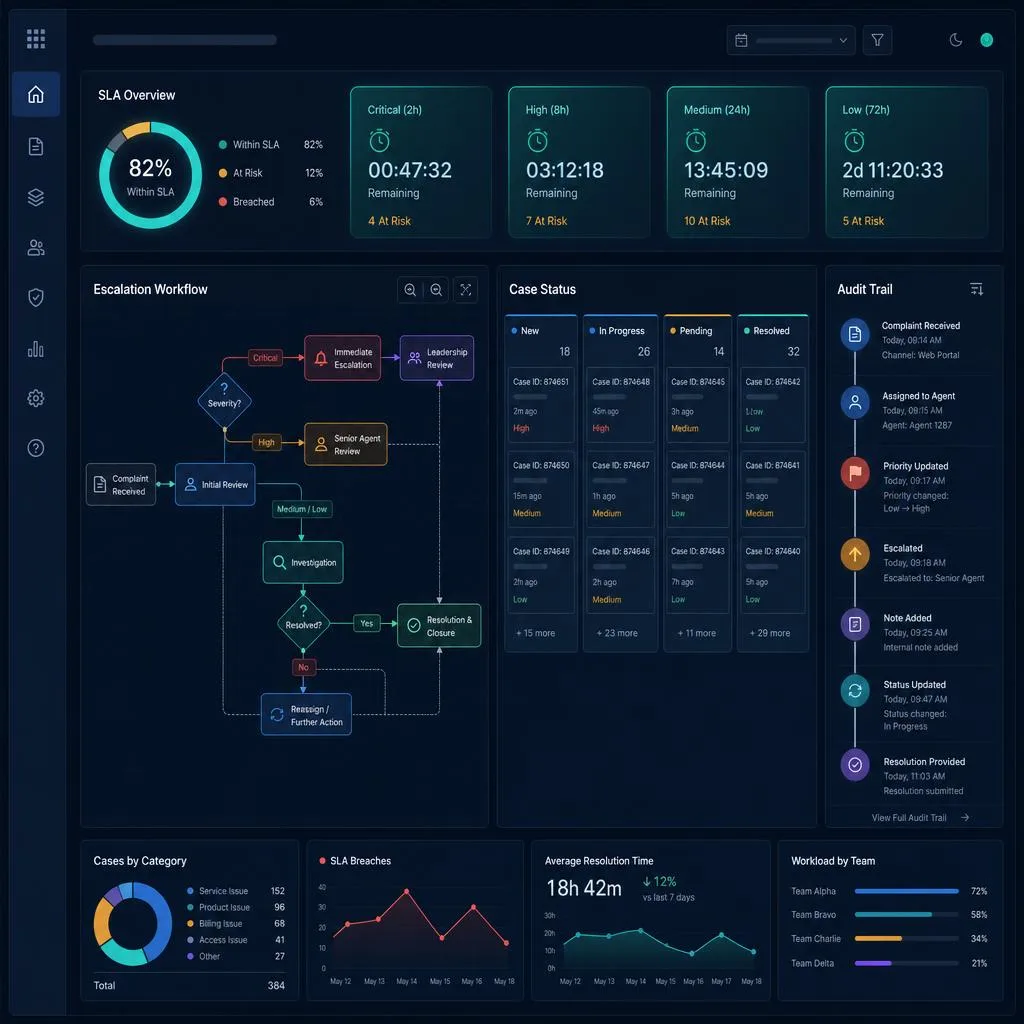
Complaint Escalation Governance
This blueprint addresses the challenge of managing complaint and grievance escalations across distributed teams without consistent SLA enforcement, structured ownership, or audit-ready documentation.
Technology & SaaS · US & Canada
Dedicated SaaS Development Pod
Series A and Series B SaaS companies reaching scale face a common engineering constraint: the founding team's velocity has slowed as the codebase matured, and recruiting in-house has a 3–6 month time-to-productivity lag that the roadmap cannot absorb.
Discuss This Scenario
Talk to us about a similar challenge
We can walk you through how this approach would map to your organization’s specific context and requirements.
Get in Touch
- Dedicated project manager from day one
- Fixed-scope or continuous engagement options
- Full IP ownership: all deliverables are yours
- Response within one business day
Explore the full Solutions library
Browse all solution blueprints and case studies, filtered by business problem, industry, service, or evidence type.